7 “Skidding over the water” – Enter the planing hull
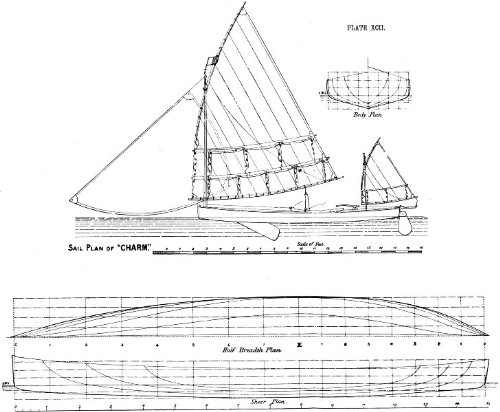
After the 1886 regattas, British canoeist quickly adopted the “deck sailing” position. “For genuine exhilaration….there is no sailing in the world to equal the deck position of a 30-inch canoe” enthused one English sailor. “Every pulsation of the craft, every flutter of the sail, every streak of wind simply means that the body must act in response and unison; it means, in short, that the hand, the eye, and every pound of the body shall work with the wind in propelling the boat….in this position a man cannot help feeling that he is a part of the machine which moves at his will, but by the force of the wind…..We can carry more sail, therefore, go faster, and enjoy sailing more on deck than before…out of fifteen or sixteen canoes we have recently been sailing with at Hendon, at least fourteen have adopted the deck position, and the unanimous opinion is much in accord with what we have expressed here.”1 In 1887, Stewart underlined the change by winning the Royal Canoe Club’s premier prize in a “Pescowic style” canoe, Charm. 2 3
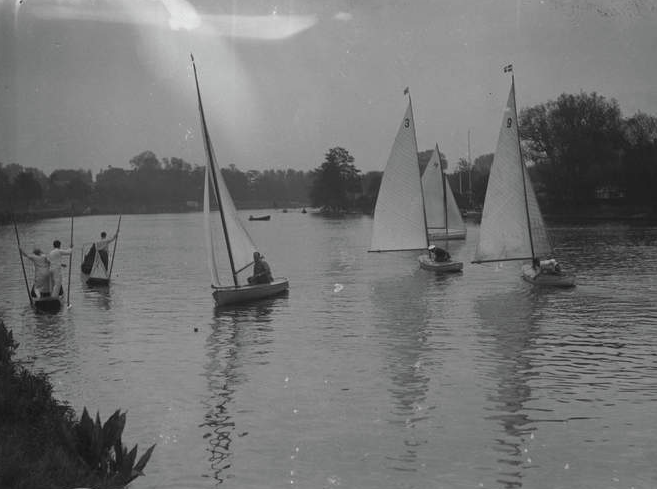
The British also instituted class rules to maintain the portability that had always been central to the canoe’s appeal; “our American cousins taught us the power gainable by sitting out to windward, we saw the danger that that position would invoke huge sails and deep wedge bodies and lead or heavy plates” wrote Baden Powell “so we limited sail area….with sail area limited and length limited, beam, centerplate and keel limits are of very minor importance, and could with advantage be simplified in the rules so as to give greater freedom of model.”4
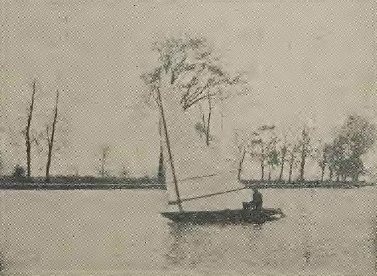
While the Brits took up the deck position with relish, it was a different story when they tried to take the next step and adopt the sliding seat. The first British canoe to adopt a sliding seat had an easy win in a race in 1892 5. But the sliding seat was (and still is) almost impossible to use in the gusts and lulls of the Royal Canoe Club’s home waters at Teddington, where the River Thames is only about 75m/yards wide and lined by trees, and the nearby Welsh Harp reservoir. The changeable English winds meant that the other American innovation of the day, the “standing rig” that could not be reefed, was also unsuited to the British racing courses.6 Reports of the early canoe races are full of mentions of calms interspersed by squalls strong enough to lay boats flat. The sliding seat canoe was simply impractical in those waters and those winds.
The Royal Canoe Club responded by taking a different path. The club created the “A” and “B” classes, also known as the “cruising canoes”, which banned the sliding seat and instead relied on heavy centerboards and the skipper hiking from a 3’6” wide hull to balance 150ft2 of sail.7 “The sliding seat canoes, after nearly killing canoe sailing owing to the tricky acrobatic nature of their sailing, have been replaced by the RCC’s A and B class canoes” wrote the designer Linton Hope, a man who was no stranger to pushing the limits but also recognised where they lay.8 “The Royal Canoe Club cruising canoe is very tightly restricted as to type and dimensions, so that it is impossible to degenerate into a useless eggshell type of a racing machine, such as those which have killed canoe sailing in America, and nearly killed it here before the advent of the present type.”9 The cruisers, wrote Linton Hope, revived the sport “when it was almost killed by the sliding-seat racing machine….A few of the racing-machine type of canoe are still in existence, but they have a very poor chance against the more modern cruiser when racing, whilst there is no comparison when it comes to pleasure sailing.”10
The creation of the “cruising canoes” and the RCC’s ban on the sliding seat may have led the way to one of the biggest leaps in small sailboat racing. Because they could not rely on the sliding seat for sail-carrying power, the British canoe designers could not follow the Americans down the path of the ultra-slender hull that sliced through the water. Instead they went down a different avenue and created ancestors of the modern planing boat.
Tracing the development of the planing sailboat is a complicated business. The concept is simple; a boat is “planing” when the movement of the hull pushes water down and in an opposite and equal reaction the hull is lifted up (a phenomenon known as “dynamic lift”) and effectively lifts the boat out of much of the drag created by its own bow and stern wave. It gets harder to tie it down more closely. The classic definition by the guru of planing hull dynamics, Dr Daniel Savitsky, is centred around powerboat hulls. Perhaps the first planing hull to be demonstrated (at least in model form) dates to the early 1870s, but the rocket-powered model was clearly not a useful inspiration for a sailing boat.
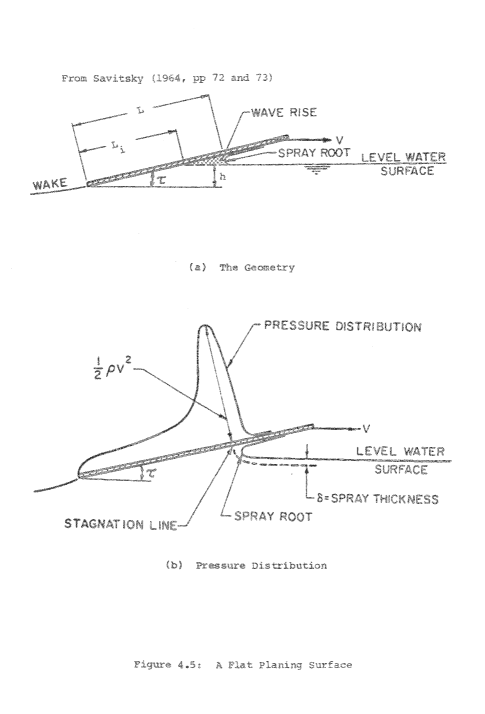
Naval architects classify a “planing hull” as one in which dynamic lift causes the hull’s centre of gravity to rise above its static point, but that’s impossible to measure in the real world.11 Many of the rules of thumb that sailors use, such as whether the boat is exceeding hull speed, are misleading – very narrow hulls like those of naval destroyers and classic catamarans, which dance to a different set of physical laws, can exceed hull speed without planing. Whether the wake runs “cleanly” off the transom is also not a reliable measure; some heavy powerboats have a messy wake even at speed, and some craft have a clean wake even when moving slowly.
Even if we could arrive at a definition of “planing” that we could easily measure while sailing, the exact definition of “planing boat” remains murky. How often does any particular craft have to plane before we label it a “planing boat”? If a boat can only plane in expert hands when running dead downwind before a gale under full sail, is it really a “planing boat”? A boat that may routinely plane in a famously windy city like Wellington in New Zealand may not plane for months on a light-wind lake. Even among planing craft there is a wide difference in feel and performance – long windsurfers, short windsurfers, 18 Foot Skiffs, Flying Dutchmen and International Canoes each have very different styles of planing. Before the Moths grew hydrofoils, even amongst the top designers and sailors there was a difference of opinion about whether they planed at all.
The proverbial mists of time and tyranny of distance make the search harder. Adding to the confusion is the language barrier. We can search English language records, but maybe some long-lost Scandinavian or Arab designer created the planing boat centuries ago. Certainly there are one or two detailed accounts of what seem to have been planing hulls in action in Asia and Australasia as early as the 1870s. But neither of these types left their mark on history. One certainly planed and the other may have, but both vanished without leaving a trace, and without influencing later generations. As far as their effect on the development of the dinghy goes, they may as well never have existed.
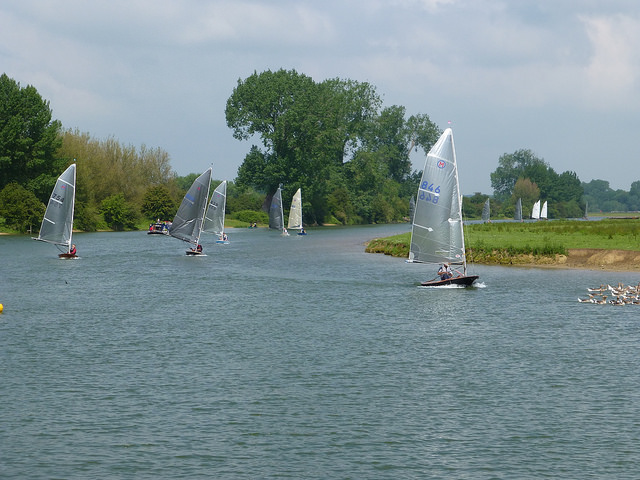
But around the early 1890s, a small group near the upper reaches of the Thames started to specifically design boats that were not just designed to plane, but also brought the concept to the attention of the sailing world. In the Victorian era the waters that run through the ancient university town of Oxford were home to a small community of sailors, apparently rather isolated from the hotbed of dinghy sailing that was developing further downstream near London. In the 1880s “sailing-boats, whose wild career used to be a terror in former days to the throngs of rowers” had been banned from the area close by the ancient town and its famed spires, because of the risk of collisions with punts and rowing boats.12 The sailors of Oxford moved even further upstream where the river, traditionally known in this area as the Isis, flows past the ancient common of Port Meadow. In this stretch the river is just 70m or yards wide, but the flat surrounding land and scanty tree cover allowed a fair breeze. It was here where Oxford don Charles Dodgson, a.k.a. Lewis Carrol, dreamed up the tale of Alice in Wonderland on a rowboat, and where “any day during term-time small centre-board boats may be seen making their way up past Godshow and on to Eynsham, while an occasional variation is afforded by a sail over Port Meadow when the floods are out.” 13

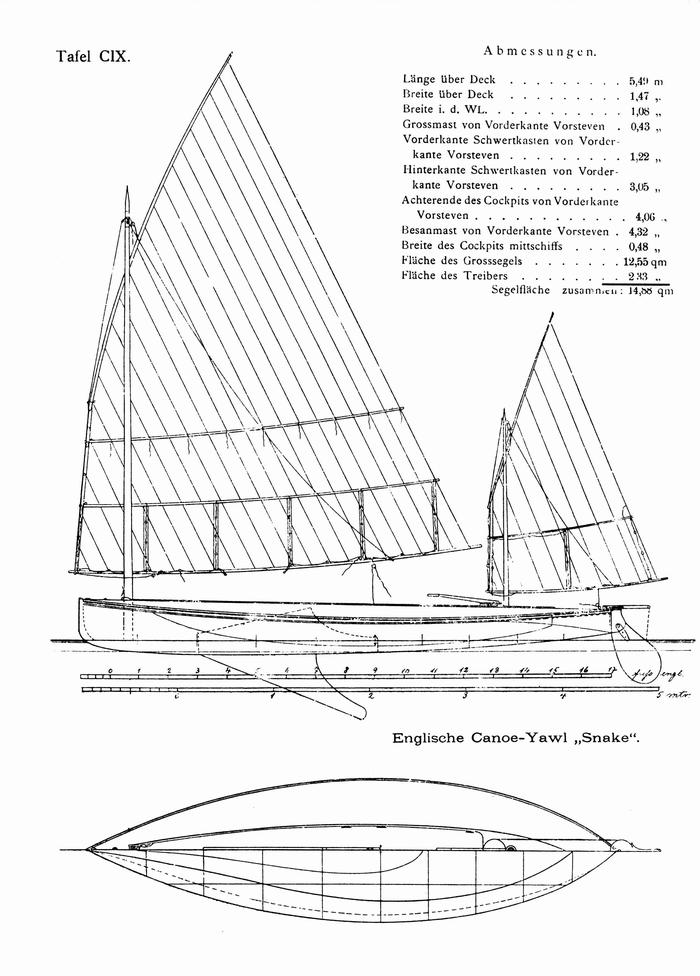
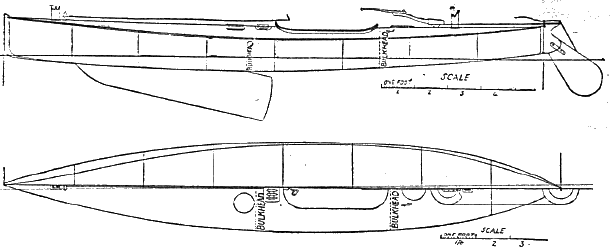
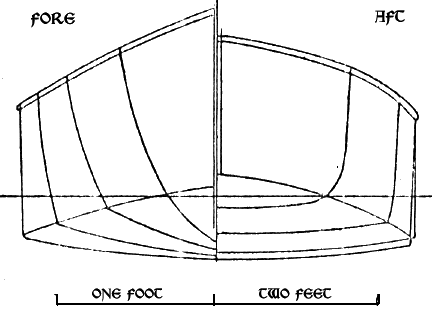
The Oxford University Sailing Club was an unusual outfit for its time. Unlike other clubs of its day, it raced over winter and even through snow, sailing a Z-shaped course squeezed into the river’s confines. It was an unlikely place for a breakthrough in boat design, but from 1888 a family of boatbuilders started developing “sharpie-style” flat-bottomed hard chine canoes. By 1890, reports in the sailing press made it clear that they were creating something new. The sailing canoe Snake was said to possess “the extraordinary power of rushing over the water at ten or twelve miles an hour, probably more, without any wave-making apparently; only a wide smooth wake is seen astern. Yet at five or six miles an hour she makes waves like any other boat.”14 Here is a description of a small planing hull in action, and a race time that proves she was no one-way flyer. Another account of contemporary British canoes describes how water passing under a canoe’s fore sections “at high speed acts on them like a wedge, tending to lift the bows”. These passages leave little doubt that as early as 1890, the British had developed a boat designed to plane.
[IMAGE HERE - snake-sections]
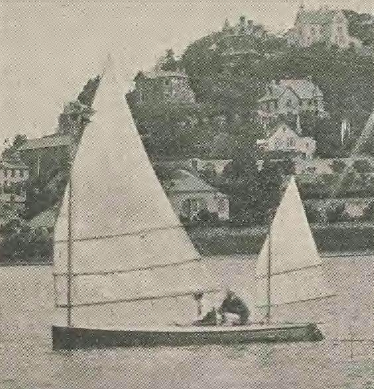
The man who created Snake was Theo Smith, one of four boatbuilding brothers. Unlike many other boatbuilders along the Thames, who relied on hand shaping their boats and left little trace, Theo and his brother Harry designed on paper and left us some records of the development of the type that became known as the “Oxford Canoe Yawl”.15. Theo Smith’s words show that the development of the planing canoe was the product of specific and planned development. “The Shadow is not, as some may suppose, the result of a “happy hit” in the way of design, but is rather the result of careful; original thought, based upon close observation of the performance of various types of boats of light displacement that have appeared on the river at Oxford” he wrote. “Although the first of the Oxford canoe-yawls she was preceded by several boats of the sharpie type, which were purely experimental, the first of these being the Yankee, followed by the catamaran Domino, the sloops Merlin and Skipjack, and the canoe Iris, boats which have in turn under favorable circumstances shown a remarkable pace. For instance, the Domino might have been seen careering over Port Meadows with about 12in. of water under her at a pace that could not be short of 10 to 15 miles an hour…. instances have been noted when the sharpies have gone apparently three times the pace of other boats in competition. By a peculiar adjustment of the surplus buoyancy and the displacement of the Oxford yawls have the faculty to a greater or less degree of “skidding” over the water, and not “wallowing” in it as most boats do. The same faculty has been attained even in the round-bodied boats, such as Wisp and Torpedo.”16
The lines of Snake and Shadow, another Smith Oxford canoe yawl, leave little doubt that they could have planed. Their rocker is flat over most of her length, with maximum rocker just 20% aft from the bow and a long straight run aft – similar to the shape that a young designer from Cowes was to make into a trademark decades later. The round bilges of Snake develop a drooping chine at the stern, to encourage the water to break cleanly away at the stern instead of wrapping around the hull. This 1880s feature can still seen on modern International Canoes.
The Oxford canoe yawls had an overhang aft, an extremely unusual feature in canoes, but as John Hayward noted it allowed them to “go about marvellously quickly”, which was a major advantage on the short courses the British canoes often inhabited, and also reduced their rating under the measurement rules of the era.
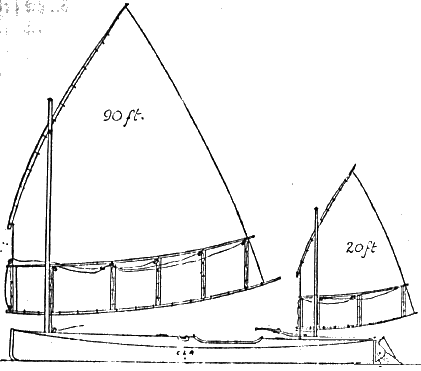
At around 5.5m/18ft overall, these were long canoes for their day, but they weighed a mere 45 to 68kg (100 to 150lb) without fittings and had big rigs and the capacity to take two or three crew to to hike the boat flat. 17
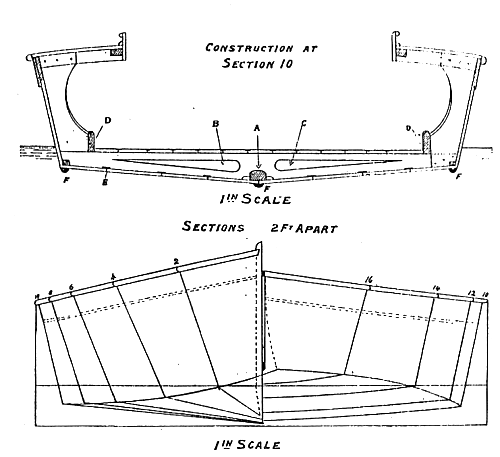
The Oxford canoe yawls proved that they were not just flat-water downwind fliers when Snake went to a British Canoe Association regatta and showed that she was “the fastest boat present” and at her best upwind. The wide sidedecks and narrow cockpit of the Smith boats meant that they could heel right over and even capsize without taking on water, although they did struggle a bit in breaking waves. 18 19 20 21 Shadow, Spruce and Torpedo, “a thing shaped more like a cigar than anything” even took on the light-displacement Rater class yachts (around 8 to 9m/25 to 30ft LOA) on the Solent and South Coast. The little Torpedo “literally sailed around them (and over them and under them for the matter of that” it was said at the time.
The Smiths continued to develop the Oxford canoe yawl style with boats like Battledore, designed and built by Harry Smith as an “improved Sharpie type” with a “Sharpie middle and after body, and canoe bowed; that is, the angular bilge as it goes forward is rounded so that the angle rounds into a U, which again flattens into a V forward”. The speed of development was shown when Battledore won the 1892 Royal Canoe Challenge Cup in “a strong steady breeze”22 by a full 16 minutes from Vanessa, formerly the Nautilus of 1883. 23
Another test came in 1894, when American canoest W.W. Howard came to race in England. The slender, flat-rockered American canoe was too hard to keep upright and too slow to tack to be competitive on the Thames. ”24 Howard came back the next year with a modified canoe that went well downwind but could still not beat the beamier British canoes on their home waters. Although the Brits admitted that on flat and open waters the slim Yankee, with her bigger rig and sliding seat, would probably beat their own craft, she was just not competitive on the UK courses, which tended to be either narrow and fluky or windy and choppy. 25
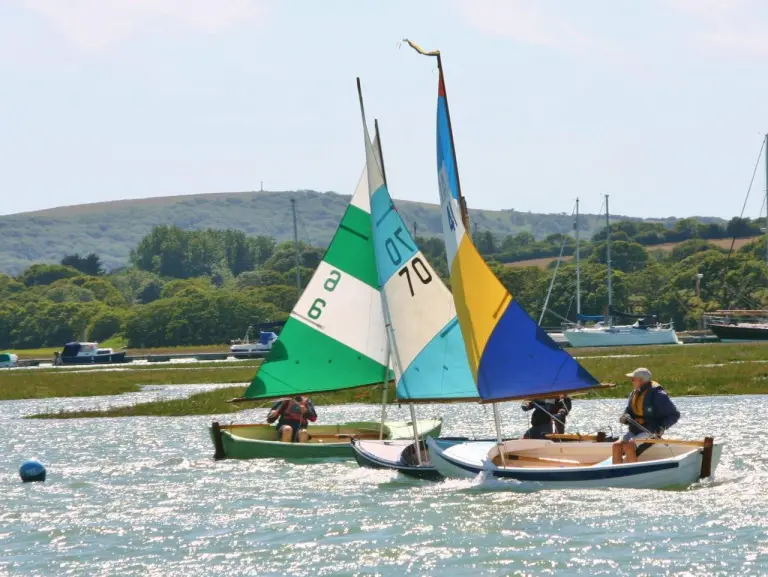
But just like the fine-lined American canoes, the Oxford canoe yawl was to fade away. Oxford was too far from the downstream and coastal areas where sailing was growing. Harry Smith moved to Burnham on the East Coast, where he became a successful yacht builder and created the Royal Corinthian One Design, which is still racing as a class 81 years later.26 Theo Smith ended building and designing boats on the Isle of Wight and became a significant figure in the development of the West Wight Scow and Bembridge Scow classes; not a flat scow like the American breed, but basically a modified pram-bowed yacht tender with a sail. He never created another breakthrough boat, but his ideas lived on – none other than Uffa Fox described him as “that great master of the canoe yawl”. Uffa used Smith’s idea of using rollers along the top of the centreboard case to support heavy centreboards instead of a normal pivot pin, and this idea was picked up by Sandy Douglass when he designed the Thistle and Flying Scot. So while Theo Smith’s writings and plans were destroyed after his death, one small part of his design skill survives in two of America’s most popular racing dinghies – and the fact that Uffa knew of his work and drew similar rocker lines makes one wonder how much of the Smith brothers’ pioneering work on planing hulls influenced Uffa’s hull shapes.
Others, such as the brilliant Linton Hope, kept on developing “cruising canoes” after the Smiths left Oxford. In 1900 Linton Hope wrote that “the modern cruising-class canoe can not only sail as well as the regular up-river racing boats of more than twice her size, but is far more suitable for confined waters, and can go equally well in the open waters of the Solent – where the up-river rater would not live five minutes – and even hold her own in fine weather with the small raters there. She is also easy to carry on a yacht or to send by rail, as her small size enables two men to lift her, and her sea-going qualities make her suitable for harbor or estuary sailing, as well as for inland waters, and she has room for her owners to sleep aboard, and to carry his kit and stores, if he likes that form of amusement.”27
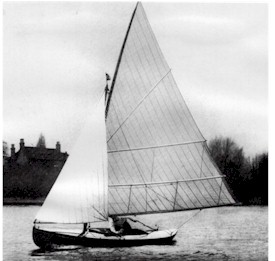
But the number of people who like that form of amusement was dropping. As early as 1891, “The Yachtsman” magazine had noted that “the popularity of the canoe seems to be on the wane in this country and the reason is not far to seek. The canoe has departed from the state of beautiful simplicity in which it existed before the introduction of such ingenious, but complicated contrivances as drop rudders, sails with patent reefing gear, and heavy centre-plates; there is now but little to choose between the complexity of gear found in a 1 rater and that in what is called a first-class sailing canoe.”28 “Canoe racing is indeed nowadays confined to a small class of experts, who can afford to build mere racing machines, which are of little value for anything else” lamented one paper. Just as in America, only a tiny number of enthusiasts remained faithful to the racing canoe.29 Cruising canoeists had caught the complication bug too….a cruising canoe competition went to a sailor who crammed a bedstead, wash stand, and tea tray into his canoe. Many ageing British canoe sailors moved into the little fully-decked double-enders that took over the name of “canoe yawl” from the lighter, smaller Smith type. To many sailors they were an ideal miniature yacht. To an old-time canoe sailor like Baden-Powell, they were “heavy, bungling, deep-drafted chungbungoes” 30 that had no more right to the “canoe” label than a battleship. But even as the British and American racing canoe faded, many of its leading lights moved on to the next type of boat that was to become a pattern for today’s sailing – the Rater.
Quoted in “History of American Canoeing Vol III”, Outing for August, 1887, p 413. Even Baden-Powell, the established leader of British canoe racing, thought that the change to lighter boats, ballasted with crew weight rather than a heavy centreboard and lead shot, would make canoe sailing more popular “if extreme types be guarded against”; Forest and Stream Jan 27 1887.↩︎
To quote Vaux in “The American Canoe Association, and its Birthplace”, Outing Vol 12 p 420, “a boat built in England on the American plan, and sailed in American fashion, won the Royal Canoe Club Cup in the spring of 1887—a great triumph for American ideas.”↩︎
Outing Vol 10 p 486 Editors OpenWindo↩︎
Forest and Stream Nov 27 1890 p 386. RATING AT THIS TIME L x Sa/6000 =0.5↩︎
Sliding seat – Forest and Stream March 24 1892 p 284↩︎
Yacht and Boat Sailing p 519↩︎
In 1890, the sail area was 112 sq ft; Forest and Stream p 386 Nov 27 1890↩︎
The Yachting Monthly, p 245↩︎
CANOE SAILING ON THE THAMES. LINTON HOPE. Country Life Illustrated (London, England), Saturday, October 27, 1900; pg. 538;↩︎
CANOE SAILING ON THE THAMES. LINTON HOPE. Country Life Illustrated (London, England), Saturday, October 27, 1900; pg. 538; “Perhaps the first planing hull to be demonstrated”: This was the Polyspheric Boat, created by a British . See for example The Pacific School and Home Journal for 1879, page 235 … “at high speed acts on them like a wedge, tending to lift the bows”. The Yachtsman, May 16 1891↩︎
Reference needed here!↩︎
AJ Church in “Isis and Thamesis”, quoted in “The golden age of the Thames”, Patricia Burstall, London 1981↩︎
Outing vol 12 p 400↩︎
Cite. Snake and her near sisters were called “Canoe Yawls”, a term that later became used for much larger and heavier cabin boats designed for sailors looking for more comfort than a standard canoe.↩︎
Thanks to John M Watkins for bringing this passage to my attention in the course of a thread he started about the history of the planing dinghy on the Wooden Boat magazine forum.↩︎
Pcge 278-8 Sept 28 1895↩︎
Hayward, Canoeing p 20↩︎
The Yachtsman, June 6 1891 p 139↩︎
Hayward., Canoeing, p 15↩︎
Forest and Stream↩︎
The County Gentleman: Sporting Gazette, Agricultural Journal, and “The Man about Town” (London, England), Saturday, August 22, 1891; pg. 1145; Issue 1528.↩︎
Hayward, Canoeing p 17 and Southampton Herald , June 25, 1892, Issue 4804, p.8, quoting The Field.↩︎
Southampton Herald , June 25, 1892, Issue 4804, p.8, quoting The Field, and Canoeing p 17↩︎
Morning Post, June 20, 1894, Issue 38073, p.3. The Rudder Oct 1904 Vol15. p544 mentions that two US canoes also failed to win the RCC Challenge Cup in 1904.↩︎
Forest and Stream Aug 31 1895 p 192, and April 6 1895 p 280. Detailed accounts of the one race that Yankee won indicate that none of the top British boats turned up.↩︎
Information on Harry Smith from “The Elegant Thames Skiff” by John Leather, Wooden Boat Magazine April 1990 p 34.↩︎
CANOE SAILING ON THE THAMES. LINTON HOPE. Country Life Illustrated (London, England), Saturday, October 27, 1900; pg. 538;↩︎
The Yachtsman, Sept 3 1893 p 458↩︎
The County Gentleman: Sporting Gazette, Agricultural Journal, and “The Man about Town” (London, England), Saturday, July 22, 1893 p 921↩︎
The Encyclopaedia of Sport. Nope, I don’t know what a chunbungoe is either.↩︎